Items Noted Elsewhere: HP’s One-Year Plan

- “Let’s say you were given a year to kill Hewlett-Packard.” — This pretty much sums up everything wrong with HP. The McDonald’s analogy is perfect.




So, we’ve had more than a week to play around with our HP Touchpads now, and the end result is I’m even angrier than I was before about HP destroying Palm. The Touchpad, while by no means perfect, is still a really cool little device. It does most of the things we expect of it. It’s nicely designed. It’s fun to use. It shows… Promise.
In the past few days I’ve spent a lot of time browsing on it. I’ve cleared through email, edited Word and Excel documents, played Angry Birds with Mathias, watched movies, and caught up on my YouTube subscriptions. The Touchpad has handled all of those tasks extremely well, too the point that the lapsed web developer in me started wondering if I could write apps for this thing. (I installed Homebrew, started reading some of the developer documentation, and then told myself to stop. Because, you know, I probably have better things to do than write applications for a dying platform.) Importing movies from DVD was a pain in the ass to figure out, likely because HP didn’t want to make it easy (“Use the HP Movie Store!”), but now that I know how to do it, it’s a snap. Doing so can allow the special, if somewhat melancholy, irony of watching Pixar movies on a Touchpad.
Many of the common criticisms of the Touchpad are valid. It can be a bit laggy at times. The number of apps available is pretty small, and the quality of those apps sometimes leaves a lot to be desired. But it’s just good enough, in that unique HP way, that one could image how it could be perfect with a few tweaks. HP seems to have a gift for coming up with great ideas and classy designs, only to cheap out on the build or materials, or push out the product before it’s fully baked. The Touchpad is a case example of trying to swing for the fences, but doing so with a wiffle bat, because, you know, plastic is cheaper than wood.
It’s a true clutching failure from the jaws of victory kind of situation. With a better build quality, a moderately lower price than the iPad, and a clear Microsoft-style commitment to the platform (to encourage app developers), HP could have had a competitor on its hands. It could have started off as the Hyundai Genesis of the tablet world—not the leader, but a legitimate competitor that forces people to take the product and the platform seriously. Instead they put out an Elantra—a fine, car, sure—and priced it like a Mercedes. The results were completely predictable.
Maybe Léo Apotheker has some of his friends and relatives short-selling HP stock. That seems as reasonable of an explanation for this fiasco as any.
It’s been a crazy and somewhat depressing week for fans of the former Palm and WebOS. I was going to give my thoughts as to the real reasons WebOS is being killed, but Gruber pretty much covered that. A related PreCentral thread summed it up even more succinctly:
If Mark Hurd didn’t like dining with escorts and expensing it, WebOS would still be alive.
Ok, labeling Jodie Fisher an “escort” may be a stretch, but philosophically speaking, that’s the nut of why the best non-Apple mobile operating system just bit the dust.
And, HP’s pleas to the contrary, WebOS’ future looks dim. With no new hardware coming out anytime in the near future—the Pre3, which is just starting to trickle out in Europe, is already a half year old at launch—and WebOS developers are clearly looking elsewhere. A new manufacturer deciding to use WebOS would be faced with a declining base of users and a moldering app ecosystem. It wouldn’t be the case of a new manufacturer taking over the ecosystem has much as being forced to reboot it.
Even the “reboot” would be unlikely, as HP is saying they don’t intend to sell WebOS, only license it. But who would it benefit to take up such a license at this point, after HP had done so much damage? If HP was serious about keeping WebOS alive and giving it a future, they would have had a licensing arrangement in place with a manufacturer before killing off their own hardware.
I don’t know what HP could have done to screw this up more than they already have, aside from maybe giving away the Touchpads while at the same time announcing they’d be turning off the App Catalog, the HP Movie Store and Synergy-related cloud services on September 1.
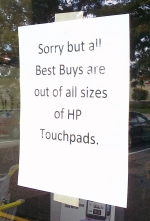
If I were a HP stockholder—and thank god I’m not—I’d look at what is happening right now as an intentional effort by HP to destroy shareholder value. They’re acting like a US version of RIM—an organization that is trying to bring the Crazy, and trying to bring it in a big way. There is an almost active disregard of their user base here, but they probably don’t care, as they see themselves as going full-enterprise. They looked at their WebOS users, those-long suffering, exceedingly patient folks who loved and saw remarkable potential in the software, and told them to go jump off a cliff. Because, you know, they won’t need us anymore anyway once all they do is consulting and big iron.
I was one of those folks who spent a stupid amount of time over the weekend trying to get a $99 Touchpad, and it’s looks like we’re going to get one. We’re getting it for a pretty specific purpose, though—a mobile movie-watching device to keep our preschooler entertained while traveling—and are practical about the future of WebOS… Of which there is none.
It’s not the heat, it’s the humidity.
Tuesday evening in southwestern New Jersey. In some ways this ends the vacation that wasn’t. From a technical standpoint, yes, we did visit Washington, Baltimore and Philadelphia, but to say we actually got to experience and enjoy the cities involves a bit of overreach. The region has been gripped by a heat wave since we got here–some of the news reports we’ve seen on TV have called this the worst heat wave in over 20 years–and the oppressive heat has made it difficult to do anything.
It’s not just the outdoors that have been a problem. The weather has kept people indoors, crowding the venues where we went to escape the weather. Museums in both Washington and Philadelphia have been packed. (The Philadelphia Museum of Art, where we were this morning, was OK, but that visit was marked by Mathias coming close to putting a stick through Monet’s The Japanese Footbridge, on loan from the MoMA.)
The highlights of the trip, as it happens, have come from visiting people we know out here. We got to visit an old college friend, Brian, and his wife Kara in DC, and a friend of Lisa’s family up near Philly. Aside from that, we’ve plodding from place to place, taking break after break to escape from the heat, seeing a lot, but experiencing very little. Mathias has been a trooper, but an overheated preschooler does not contribute to a great trip.
We’re already talking about coming out here again a few years from now. Mathias may be a more appropriate age to enjoy some of what we’re seeing, and I can better plan for weather, Amtrak delays and other variables. This trip would’ve been aggressive for me traveling solo. I’m not sure what I was thinking thinking we could do all of this with a four-year-old in tow.
~ ~ ~
And now it’s sad that I have to do this, but I have a paper to write for my last MBA class. More later.
Well, we’re in DC. The original plan was for us to arrive here on Amtrak yesterday afternoon, but the fatal flaw with that plan was having “plan” and “Amtrak” in the same sentence. The Empire Builder rolled into Chicago over three hours late, meaning our connecting train, the Capitol Limited, was already rolling east without us. Amtrak basically gave us three options: Take the train to New York and then connect to DC, a route that would get us into DC well past 11:00 Thursday night; stay at an Amtrak-booked hotel in the Chicago ‘burbs, and then run coach on the Capitol Limited (i.e. the “overnight coach with a four-year-old” option); or get a refund and make our own way to DC. While the overnight train trip was supposed to be one of the highlights for the trip for Mathias, with our planned option off the table, I wanted us to have control over our own destiny, so I got a one-way rental car from O’Hare and got us the heck out of there.
Additional train wrecks followed the missed Amtrak connection. After a tedious cab ride out to O’Hare that included the cab driver having to stop for gas, we got the car and made it to South Bend, Indiana, which seemed as good of a place to overnight as any. 1:30 in the morning is not a great time to find out that all the hotels are booked solid, but they were, and it took six hotel stops for us to finally grab a $140 room at the Comfort Suites—the last open room in the hotel. The next morning we learned there was a twirling competition in town, which made the breakfast area of our hotel look a bit like a scene out of Little Miss Sunshine, but at least the kids were quiet.
The drive across Pennsylvania was interrupted by a huge accident backup near Pittsburgh that cost us well over an hour and a half, and a construction backup in Maryland cost us another hour. In the end, it took some automotive contortion for me to get the rental back to Budget by a time reasonably approximate to its due date, only to find their “24-hour” operation at Reagan National unstaffed.
And so we spent today in DC. We drove around, visited the Air & Space Museum (which was packed), and did our best to avoid the heat. We’re camping in a friend’s house out here, and by all indications, Mathias seems to prefer lounging on couch in air conditioning than heading outside. And that’s something I completely understand.
Sometime within the next hour the folks who own this place should show up, and we’ll see what plans we can put together for tomorrow. Then Saturday night we’ll be heading up to Baltimore for a day there, and after that it’s a couple days in Philadelphia. If the heat will hold back for a bit it should be fun, but if not, I expect we’ll be staying indoors a lot.
I’d been hoping to get a few more posts in since returning from Europe, but life has been pretty stacked up. There are a few papers that are suddenly going to be due in the next week or so, too, so posting here is a break more than anything.
Mathias had his fourth birthday party last weekend, a bit later than his actual birthday due to me being in Europe. We’ve had birthday parties for him before, of course, but this one seemed to be a bit more legitimate due to the depth with which Mathias seemed to understand that this party was happening because he was getting older and/or bigger. Anyway, it was a tremendously unorganized affair–we had snacks, but the kids basically could just go run anywhere whenever they wanted–which seemed to suit both the kids and parents just fine.

So, while last weekend was great, this one kind of sucked. My Saturn blew its engine in central Wisconsin, and we’re now looking for a new car.
I have an irrational emotional attachment to my car. Here’s what I posted about it on Facebook:
The car has scaled the Rockies; touched both coasts and the Gulf of Mexico; survived traffic in Los Angeles, Chicago and Manhattan; driven up Highway 1 and down Interstate 95; taken my wife on her first trip to the Badlands; taken my son on his first camping trip; and, of course, reliably carried me to work and school for over seven years. It now sits in Owen, Wisconsin.
I briefly looked at Saabs available in the Twin Cities, but there’s not much worth buying that doesn’t exceed my broke-grad-student debt tolerance. The rental has to be returned to Wausau on Saturday, so it’s time to get looking.
Well, I guess one more entry from Copenhagen. I’m in my usual breakfast spot, only this time, for the first time in over a week, I’m not surrounded by classmates. About half the class is in transit at this moment. Me, I have a later departure today, so I’m leaving with a large pack of folks around 11:00.
Programs like this can be a weird beast. It’s rare that one gets a chance to intensely study a specific subject in a foreign place with a group of folks who are, at the beginning of the trip, largely strangers. This class represents the sixth such experience I’ve had–three in high school and three as a grad student–and it seems the ending of these brief periods always define themselves much more distinctly than other life experiences. The difference, maybe, is that they create a completely transitory community, one that can only exist for a brief period before scattering. (I’m somewhat reminded of that town in Canada that was intentionally shut down after the local mine closed.)
There’s also a weird quality to time on trips like these, especially when away from one’s loved ones. I’m not just talking about the general acceleration that happens as a trip nears its end, but how the timeline of the trip itself begins to contort. I’m looking forward to seeing my wife and son later today, but in some ways it feels like I was with them just a few days ago. Oslo, on the other hand, seems years distant. History as I feel it is different from what clearly must be true.
I have a ridiculous amount to write about from the class and the trip. (I’ve apparently been using “ridiculous” quite a bit over the past two weeks. Also, “rabid.”) The subject matter may have to wait a bit, as I’m really split on a number of items covered in the class. There’s something going on here, but the idea of corporate social responsibility, and the way many organizations are approaching the topic, may be distracting people from deeper, more important issues. As for the cities and the experiences, I’m already arriving at the point where I’ll need my photos to remind me.
Eight hours to Amsterdam, 18 to Minneapolis. More later.
Saturday morning, the start of my last full day in Copenhagen. I’m in the breakfast area of the Savoy Hotel–or, as I’ve been describing it, Lake and Cedar with fewer dead people–and am only a few hours away from my last MBA class.
My initial reaction to Copenhagen was anything but positive–it seemed just like Oslo and Copenhagen, except dirtier, with uglier architecture, and with graffiti everywhere–but I’ve softened on it since, and now it may actually be my favorite city of the three we’ve visited. The city has a bit of a New-York-in-the-1970s-vibe that is kind of endearing. One key problem with that analogy, though, is that I’ve never felt unsafe here. I commented to a fellow traveler last night that I couldn’t remember the last time I saw a cop, and he mentioned that he couldn’t, either.
The food here, especially that of the baked variety, is great. The coffee is a crime against humanity.
Well, it’s approaching 9:00, and I have to return my bike to the central train station before I head to class today. (The hours for pretty much everything other than alcohol are inconvenient. Most stores are open from 10:00-6:00, a fact that has foiled us almost every day.) I have to be going. This will probably be my last post from Copenhagen.
More later.
Monday morning in Stockholm. Once again I’m blogging at breakfast. The second week of the program is officially underway — in just under a half hour we’re off to more site visits, and then this evening we’ll be on the overnight train to Copenhagen.
Stockholm has been amazing, and I’ll definitely have to get Lisa and M over here sometime. The weekend was a mix of relaxing on the islands, museum hopping, bars, and amazing food. (I had three fantastic meals on Saturday, and that’s not counting breakfast.) The weekend will likely be better described through commentary through photos, though, so I’ll wait until I have time to do that to share more.
In one way this trip has been like both of the other Carlson trips I’ve been on: It’s long and fast at the same time. It feels like we’ve been here forever, but at the same time it’s difficult to believe it’s more than half over.
Well, I need to finish packing. More later.
Friday morning in Stockholm. Once again I find myself blogging in the breakfast area, but I guess that’s OK as I’m apparently one of the early risers on this trip. When I did the Carlson seminar to India there was a huge group that gathered each morning to discuss the previous day’s events, but this is tuning out to be more of a dissection-over-beer kind of trip.
Stockholm was kind of a shock, especially after the relative Portland-like style of Oslo. The first day in Oslo I commented–jokingly–that the city appeared to be populated by slackers. That cannot be said here. This city seems to have more in common with London and New York than it does with the capitol to the east.
Today we have a couple of site visits, a class, and discussion on what the hell to do over the weekend. There’s no shortage of options for the weekend, so we’ll have to plan carefully… And aggressively.
Well, the breakfast crowd is showing up. More later.
in transit—a lame attempt at a homepage since 1996—is a service of Mark Danielson and nonlocality.com.
© 1996-2006 by Mark Danielson. All rights reserved unless specifically noted.